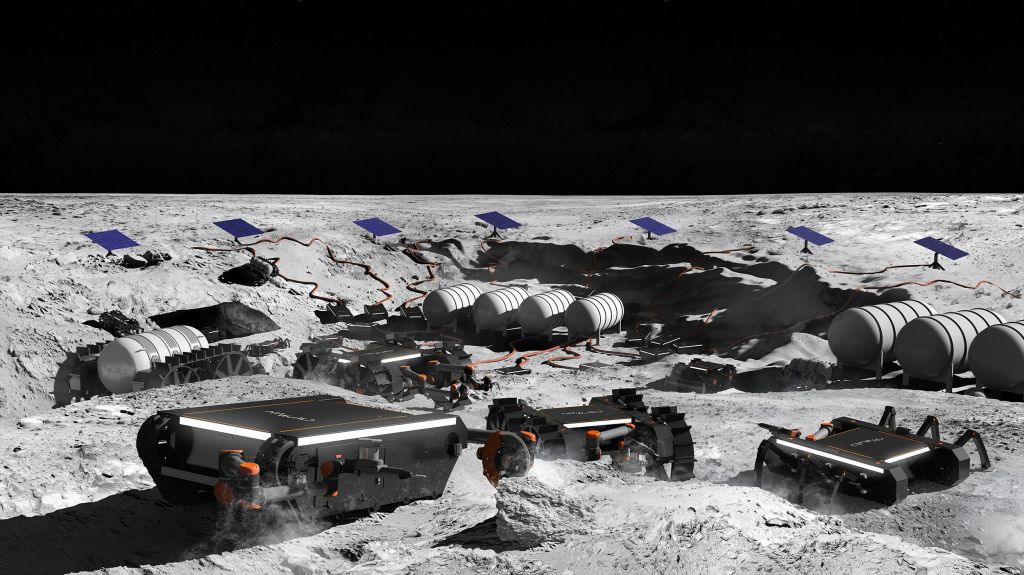
Engineers at the University of Arizona are developing a plan to mine the Moon’s surface using autonomous swarms of robots and cutting-edge excavation techniques combined with machine intelligence.
It’s possible that lunar mining will become a reality. Nasa stated in September that it would pay private enterprises to extract lunar regolith (the rock and dirt that covers the surface) in the hopes of creating universal norms for space business.
Mining on the Moon could be a more efficient technique of constructing structures on the lunar surface because it would eliminate the need to carry rock, dust, and dirt from Earth. It could also provide rare earth metals, titanium, precious metals, and helium-3, which are essential in electronics like cellphones and medical gadgets (which is rare on Earth).
Now, with Nasa support, a team from the University of Arizona is working on improved space-mining methods.
Professor Moe Momayez, interim director of the department of mining and geological engineering, said, “It’s incredibly thrilling to be at the forefront of a new discipline.” “As a kid, I recall watching cartoons like Space: 1999, which is about Moon bases. We’re in the year 2021, and we’re discussing colonising the Moon.”
Miners must drill through rock to extract core embedded in it on Earth. Momayez is an expert in this field, having devised an electrochemical approach for drilling through rock that is five times faster than any other method. Lunar mining, on the other hand, poses additional obstacles.
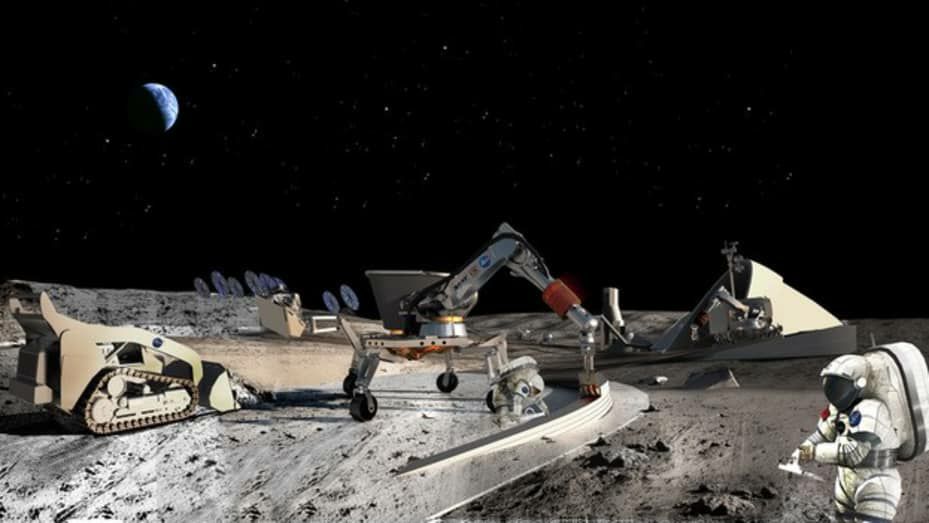
“We have a limitless amount of energy to throw towards cracking rocks here on Earth,” he remarked. “You have to be a lot more cautious on the Moon. For example, we require a lot of water to crush rocks, which is something we won’t have on the Moon. As a result, we require new methods and procedures. On Earth, blasting is the most efficient way to break boulders, yet no one has ever set off an explosion on the Moon.”
The University of Arizona researchers plan to overcome the problem by using autonomous robotic swarms. They intend to develop and train robots on Earth before launching them into space, using a unique neuromorphic learning architecture technique called as HEART. This will not only teach robots to work together on mining, excavation, and construction projects, but it will also allow them to enhance their collaboration skills over time.
The researchers expect that, in the future, the robots will be able to work in a fully autonomous swarm, mining resources and constructing rudimentary structures without the need for orders from Earth.
“In a sense, we’re like farmers,” said Professor Jekan Thanga, who invented the HEART system. We’re breeding skill in these creatures, or a family of species, to perform specific duties. We help perfect these artificial beings whose duty it is to perform mining duties by going through this process.”
While the team believes that humans are an important part of space exploration, they believe that robot swarms could free up astronauts’ time to focus on other aspects of the mission. “The idea is to have the robots build, set things up, and do all the dirty, boring, dangerous stuff so the astronauts can do the more interesting stuff,” Thanga explained.
 techtronicz
Leave a comment