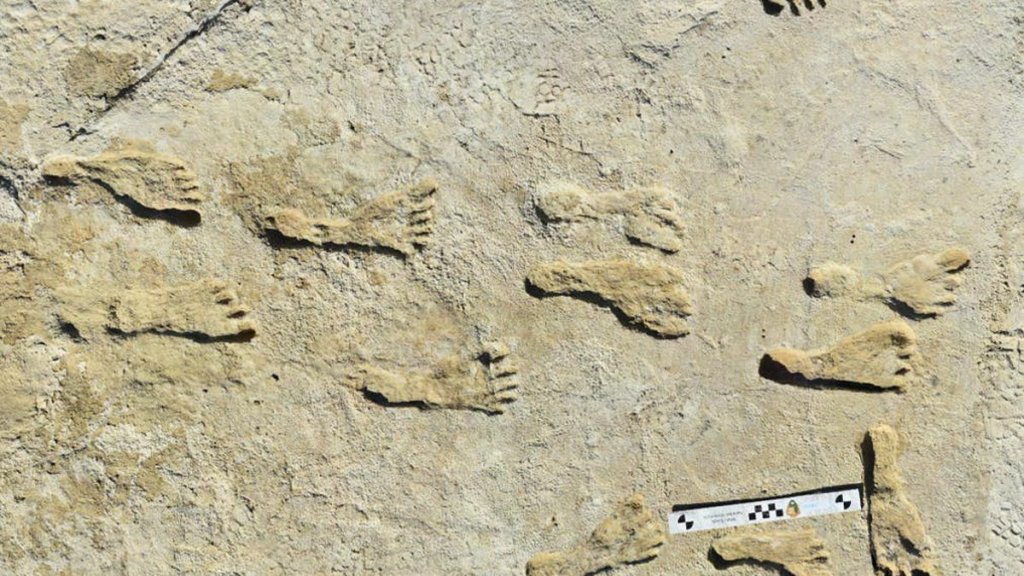
According to recent research, humans arrived in the Americas at least 7,000 years earlier than previously assumed.
Many researchers are sceptical of evidence for humans in the North American interior much earlier than 16,000 years ago.
Now, a team working in New Mexico has found scores of human footprints dated to between 23,000 and 21,000 years old.
The discovery could transform views about when the continent was settled. It suggests there could have been great migrations that we know nothing about. And it raises the possibility that these earlier populations could have gone extinct.
The footprints were formed in soft mud on the margins of a shallow lake which now forms part of Alkali Flat in White Sands.
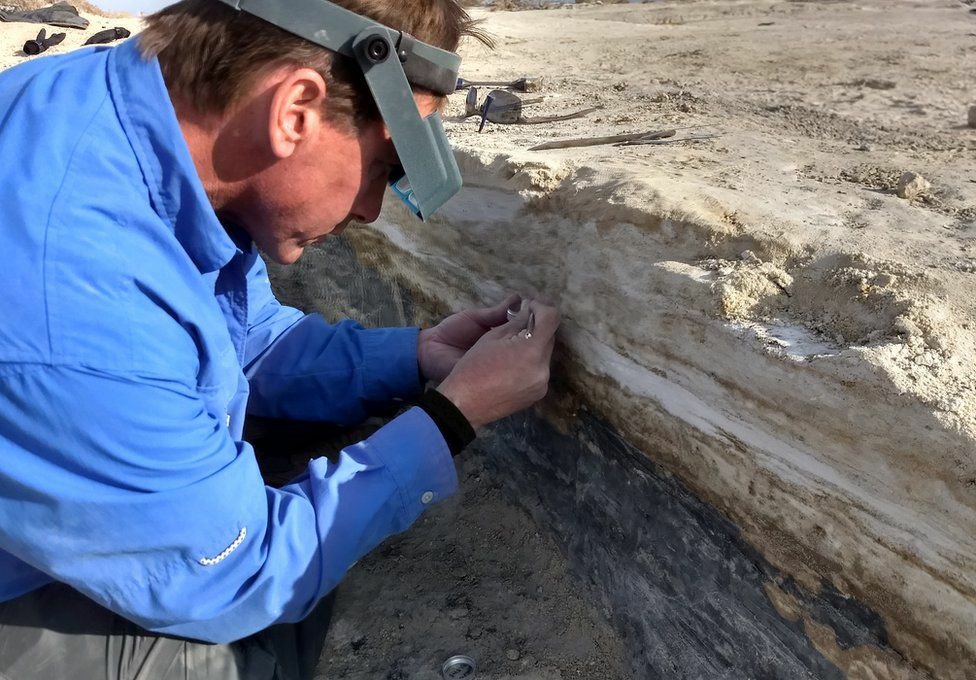
A team from the US Geological Survey carried out radiocarbon dating on seeds found in sediment layers above and below where the footprints were found. This gave the researchers remarkably precise dates for the impressions themselves.
Based on their sizes, scientists think the tracks were made mainly by teenagers and younger children travelling back and forth – along with the occasional adult.
They offer a fascinating window into what life was like for these early occupants of what is now the South West US.
The scientists don’t know for sure what the teenagers were doing, but it is possible they were helping the adults with a type of hunting custom seen in later Native American cultures. This was known as the buffalo jump and involved driving animals over a shallow cliff edge.
The animals “all had to be processed in a short period of time,” explained Dr Sally Reynolds, co-author from Bournemouth University. “You’d have to start fires, you’d have to start rendering the fat.” The teenagers could have been helping out by collecting firewood, water or other essentials.
The age of the discovery is key, because there have been countless claims of early human settlement in the Americas. But virtually all are disputed in some way.
It often comes down to a debate over whether stone tools found at an ancient site are in fact what they appear to be, or are simply rocks broken through some natural process – such as falling from a cliff.
The proposed artefacts at early locales are sometimes less clear-cut than the exquisitely crafted spear-points found in North America from 13,000 years ago onwards. This leaves the door open for doubt about their identity.
These big game hunters were thought to have crossed a land bridge across the Bering Straits that connected Siberia with Alaska during the last ice age, when sea levels were much lower.
As the “Clovis First” idea took hold, reports of more ancient settlement were dismissed as unreliable and some archaeologists actually stopped looking for signs of earlier occupation.
But in the 1970s, this orthodoxy was challenged.
In the 1980s, solid evidence turned up for a 14,500-year-old human presence at Monte Verde in Chile.
And since the 2000s, other pre-Clovis sites have become widely accepted – such as the 15,500-year-old Buttermilk Creek Complex in central Texas and the 16,000-year-old Cooper’s Ferry site in Idaho.
Now, the footprint evidence from New Mexico suggests humans had made it to the North American interior by the height of the last Ice Age, when massive ice sheets covered much of what is today Canada. This would have blocked entry to humans crossing from Asia, perhaps suggesting that humans arrived even earlier when pathways through the ice were open.
 techtronicz
Leave a comment